
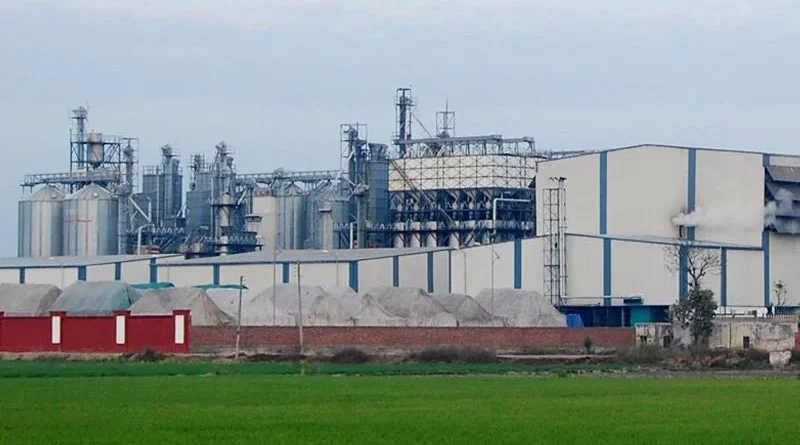
Storage crunch forces Punjab rice millers to slow milling, just 25% done ahead of April wheat harvesting
By Anju Agnihotri Chaba
Punjab is heading towards a serious grain storage crunch as slow evacuation of rice and wheat to the Central Pool, managed by the Food Corporation of India (FCI), and delayed rice milling have clogged warehouses, godowns, and rice mill premises across the state, just weeks before the wheat procurement season begins.
Rice milling for the 2025–26 crop year has progressed at an unusually slow pace, with only about 25 per cent of procured paddy milled so far, compared to nearly 60 per cent in a normal year by this stage. Industry representatives attribute the delay not to milling capacity but to FCI’s lack of storage space, which has slowed acceptance of rice from mills.
The situation is particularly acute in Sunam, a major procurement and milling centre, where FCI warehouses have effectively run out of storage capacity. With godowns saturated, movement of rice from mills has slowed sharply, forcing millers to hold large quantities of paddy for extended periods.
“With FCI storage at zero level in Sunam, the entire supply chain has choked,” said Prem Goel, president of the Akhil Bharatiya Rice Sheller Sangh. “There is no clear roadmap for lifting rice, including improved rice with 10 per cent broken for the 2025–26 season. Unless old stocks are evacuated on priority, managing fresh wheat arrivals will be extremely difficult,” Goel said.
10.5 million tonnes of rice to Central Pool
Punjab is expected to deliver around 10.5 million tonnes of rice to the Central Pool from about 15.6 million tonnes of paddy procured during the kharif marketing season. At the same time, wheat procurement is set to begin in April, with the state likely to contribute nearly 13 million tonnes, further straining storage infrastructure.
Rice millers also point out that stocks from earlier crop years are still occupying critical space, leaving little room for fresh arrivals. Prolonged storage of paddy on mill premises increases the risk of quality deterioration, particularly during summer and the approaching monsoon.
It is learnt that around 18 million tonnes of grain, rice, and wheat are stocked in Punjab’s godowns from the previous years.
Severe logistical challenges likely
State officials acknowledge the pressure and say the issue of slow evacuation has been raised with the Centre. Experts warn that without faster inter-state movement of grain and timely lifting of older stocks, Punjab could face severe logistical challenges during the peak procurement period.
Government-procured paddy continues to lie at the premises of nearly 5,000 rice shellers across the state. Under the existing system, millers are responsible for milling the paddy and delivering rice to FCI, but with transportation slowing down, the milling has slowed down.
“The timing could hardly be worse. Wheat procurement is set to begin within the next two months, with arrivals expected to peak in April. Punjab is projected to procure nearly 13 million tonnes of wheat this rabi season, which will again flow into the Central Pool. Without rapid evacuation of rice, officials fear there will be little space left to handle fresh wheat arrivals,” added Goel.
Rice millers also point out that stocks from the 2023–24 season are still lying in storage, occupying critical space. “Old rice must be lifted first to create room. In several districts, storage availability is effectively zero,” said a representative of a rice millers’ association.
Prolonged storage of paddy on mill premises has financial and operational consequences. Extended holding increases the risk of moisture loss, pest infestation, and quality deterioration — factors that often lead to disputes at the time of delivery. “If grain quality suffers due to heat or rain, millers face rejections and penalties, even though the delay is not of our making,” Goel added.
State government officials acknowledge the mounting pressure but refused to be quoted.
“Punjab procures far more grain than it consumes. Timely movement to deficit states is essential. Any delay creates a chain reaction on storage, milling, and fresh procurement,” the officer said.
“Every year, we see the same stress points — delayed lifting, storage shortages, and last-minute firefighting,” said an FCI officer.
Punjab has a total covered foodgrain storage capacity of about 173 lakh metric tonnes (LMT), including nearly 48 LMT with the FCI and the rest with state agencies such as warehouses, Markfed, and the Punjab State Civil Supplies Corporation (PUNSUP). Silo capacity in the state stands at about 6 LMT.
Although Punjab procures around 300 lakh tonnes of grain for the Central Pool annually, the actual storage requirement is lower due to the regular movement of grain to consuming states. FCI sources say 190–200 LMT of storage space is adequate if grain movement remains smooth.
This article has been republished from The Indian Express.